
-
Call us9846818877


Will Plywood Swell in Water? What Happens to Different Boards in Humid Conditions
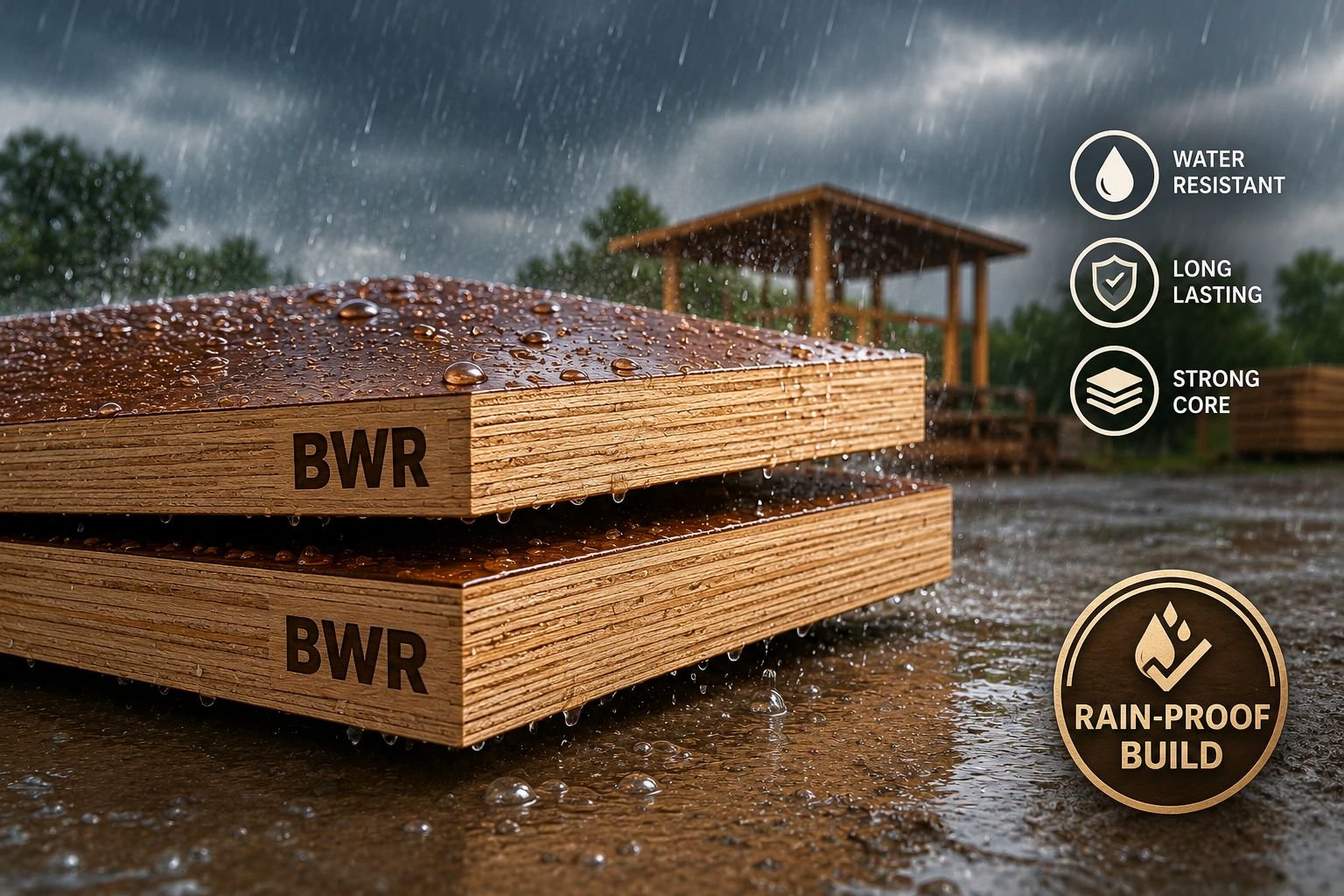
The monsoons of Kerala are beautiful but ruin interiors. Months of high humidity and flooding means that furniture and cabinets are regularly exposed to moisture. This is particularly bad for wooden parts like wardrobes and kitchen cabinets. As a result one of the first questions a house owner or a designer in Kerala asks is ‘will plywood swell in water?’
It most definitely will. It's important to understand how different types of boards will behave to know which one is safe to use. As one of the leading dealers in interior materials in Kerala, this is what you need to know.
Will Plywood Swell in Water?
Plywood is made of several layers of thin wood veneer glued together. Each subsequent layer is crossed with the previous. As a result, plywood is stronger and more stable than solid wood. However, plywood absorbs moisture, just like solid wood, and can swell with direct contact to water.
Different adhesives are used to glue together plywood layers.
- MR grade plywood is safe for interior use, as the moisture resistant adhesive used in its manufacturing helps in reducing chances of delamination. Over time, humidity and dampness can cause the edges to swell, and layers to separate.
- BWR plywood, yet again, has a better adhesive than MR grade plywood, and can also be used in areas such as kitchens and bathrooms, that are humid and steamy.
- For plywood to be completely waterproof, it has to be made with a special waterproof adhesive and resin, like the one used to make marine plywood (BWP). Marine plywood is most appropriate to be used for outdoor structures and interiors of boats and other watercraft.
Swelling of plywood is not avoidable if it is subjected to moisture for long periods. BWR and marine grade plywood prevent swelling the most. Marine grade plywood has edge sealing, but if left unsealed, will absorb moisture the fastest.
What About Other Boards?
There are other materials available for interior decorations besides plywood. Here are some other boards and how they behave in the presence of moisture.
1. MDF (Medium Density Fibreboard)
If painted over, MDF looks good and takes paint well, but it is highly absorbent and soft. Moisture gets in and MDF quickly loses its shape, and strength, and will not return to its original shape. It is recommended that MDF be used for dry areas, and for humid areas, use the MR (Moisture Resistant) or HDHMR (High Density Hand Molded Resin) boards.
2. Particle Board
Particle boards are used to make cheap, less durable, furniture. Being less durable, it loses strength, crumbles and disintegrates in the presence of moisture. In the state of Kerala, it is not recommended for use for the ground floor, or bathroom and kitchen storage.
3. HDHMR (High Density High Moisture Resistant) Board
This board has many uses and is an upgrade from MDF. It has a lower swell and better screw-holding strength. It swells very little when exposed to moisture and is a good choice for use in modular kitchens and wardrobes. It must be properly laminated and edge sealed.
4. Blockboard
This board has a core of small blocks of wood that are sandwiched between veneers. It is strong and has good screw-holding strength. It is not moisture resistant and water can seep through the core. Because of this, the board can warp and swell. There is a wide variance in the quality of this board. Buy from a good, reliable source.
5. WPC (Wood Plastic Composite) Boards
WPC boards are made from a mixture of wood fibers and polymer. They are water-proof and termite-proof and therefore, will not swell. They are a good choice to use in places that have moisture like bathrooms or kitchens. They do cost more, but will save money in the end since they will not need to be replaced.
Protection from Moisture for Boards Installed in Homes of Kerala
Even the best material needs a good installation. Extending the life of interiors can be done by doing the following:
- Seal all Edges: All cuts must have edge banding or a sealant. All exposed edges and cut-outs must be sealed with edge banding or sealant.
- Laminate or Water-proof finish: A good laminate or water-proof finish can serve as a barrier and seal edges.
- Adequate Cross-Ventilation: Trapped moisture in cabinet and wardrobe interiors can be eliminated with cross-ventilation
- Keep boards off the floor: Boards must not be in contact with the floor.
- Use PVC or metal legs for bases to keep the board from being in contact with water.
Repair leakages. A leak behind a cabinet can damage a board in no time.
- Don’t use a bedroom board in the kitchen. Using a lower quality board can lead to a lot of issues.
Choosing the Right Supplier is Important Too
A board can fail if the raw material used to make it is sub-standard. Hence, a reliable supplier is as important as the material itself. The best interior material supplier in Kerala will give you correct information about BWP, MR and BWR boards and what is the right material to be used in what room instead of just selling you the most expensive board.
When you look for an interior products supplier in Kerala, check for:
- A wide range of plywood, laminates, HDHMR, WPC and hardware under one roof
- Authentic brands with clear grading and certification
- Honest guidance on what suits Kerala's humid climate
- Fair Pricing and Dependable Delivery
- Good After Sales Support
Woodmall understands the Kerala climate and helps builders, architects and home owners choose construction materials that last.
As Interior material dealers in Kerala, Our focus is on selling durable products. We give our valued clients practical tips on how to keep their interiors looking great through the monsoon seasons.
Final Thoughts
Will plywood swell in water? Of course it will, especially with lower grades and exposed edges. But with the right grade (BWR or marine plywood), sealed edges and a good installation, you can easily tackle the humidity of Kerala. For higher moisture areas, better options are HDHMR or WPC boards, while MDF and particle boards are best left in dry areas.
Using the right material at the beginning helps avoid swelling and warping and expensive replacements later on. Talk to a supplier with a good understanding of the building material business, ask the right questions and go for a material that is appropriate for your area.
FAQ
1. Can water damage plywood?
A. Yes, plywood can swell when it's left in wet conditions for extended periods, especially with commercial-grade plywood with unsealed edges. BWR and marine plywood are designed to withstand moisture and swell a lot less.
2. Which plywood should be used in areas like Kerala?
A. In humid areas like kitchens and bathrooms, BWR plywood is a good option. Marine plywood should be used where water is constantly in contact with the wood.
3. Can plywood return to its original shape after swelling?
A. Mild swelling allows the board to shrink back down, however, the board loses strength in the process. Replacement of very swollen and delaminated plywood is recommended.
4. Is it alright to utilize MDF in humid conditions?
A. Standard MDF is not suitable for use in humid conditions. Standard MDF swells when in contact with moisture. For humid conditions, it is recommended to use the MDF/HDHMR that has been treated to be resistant to moisture and seal all edges.
5. What is the most waterproof board for interiors?
A. WPC boards are fully waterproof and termite proof and marine plywood is the most water resistant of the wood based boards.
Explore our range of BWR Plywood for home, office and interior applications at Wood Mall.
